Towards Fairness under Label Bias in Image Segmentation

Impact, Measurement and Mitigation

Accepted at NeurIPS 2026 · Paris

Aditya Parikh
Aditya Parikh
Stella Frank
Stella Frank
Sneha Das
Sneha Das
Aasa Feragen
Aasa Feragen
Technical University of Denmark, DTU Compute

What this paper does, in three points

  1. Label bias changes what the model learns. When one subgroup is annotated differently, the subgroups drift apart in feature space. The more bias, the further apart they get.
  2. You can detect label bias without clean masks. We adapt Confident Learning to segmentation. It audits the training set against itself and tells you how much bias there is, in which direction, and in which subgroup.
  3. Training dynamics show which subgroup is biased. The subgroup with the lowest training loss has the cleanest labels. We condition the decoder on the subgroup and predict every image in that clean style.
Label bias in segmentation

Two groups, annotated in two different ways

true objectgc annotationgb annotation

Under-segmentation

The mask is shrunk. Missed object pixels in red.

Over-segmentation

The mask is grown. Extra background pixels in orange.

Irregular boundary

The boundary wobbles. Some pixels missed, some added.

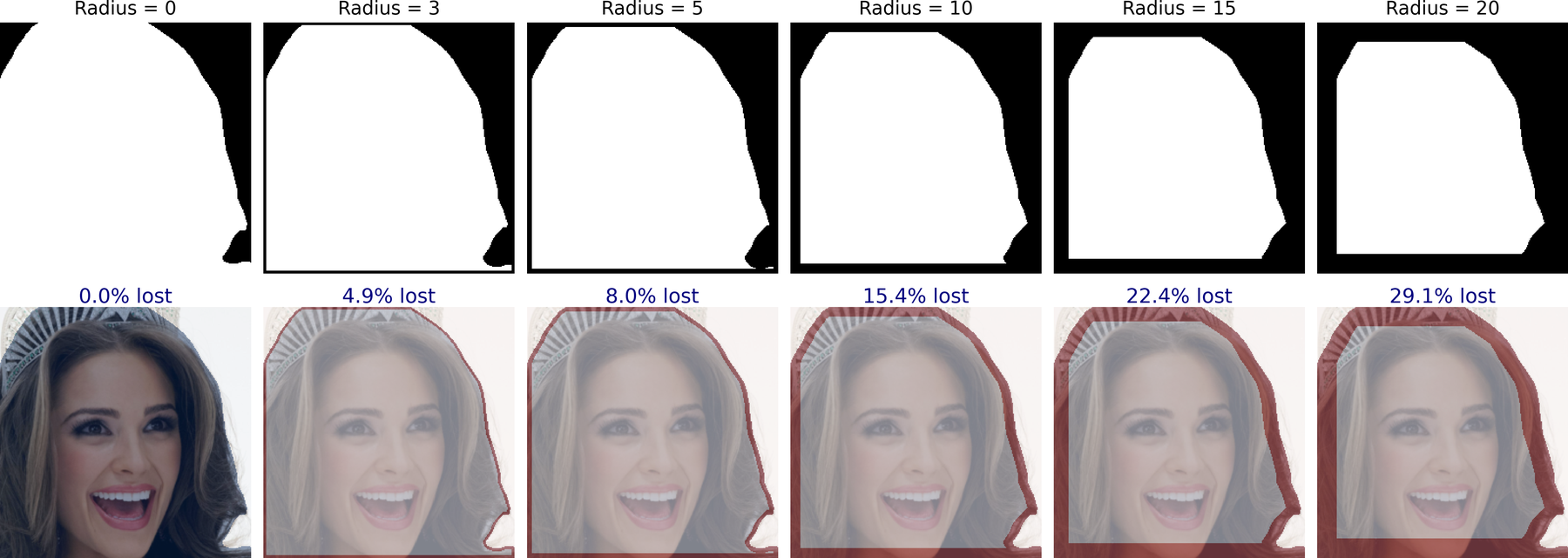
Erosion radius sweep on a CelebAMask-HQ face mask
CelebAMask-HQ: we shrink the face mask by a growing radius to create controlled under-segmentation.
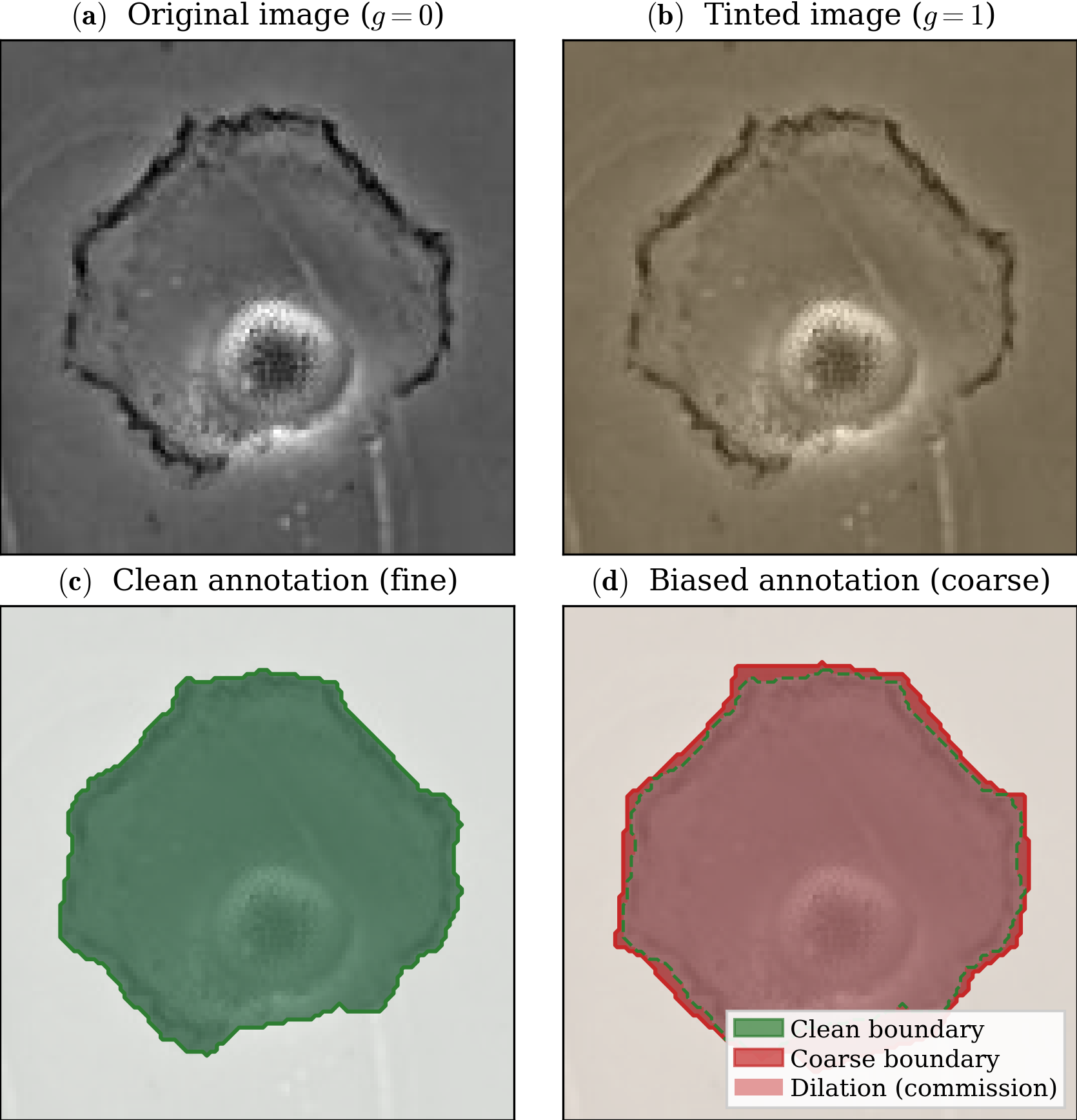
PhC-U373 fine vs coarse annotations
PhC-U373: two real human annotations of the same cell, one fine (green) and one coarse and too big (red).
The bent ruler

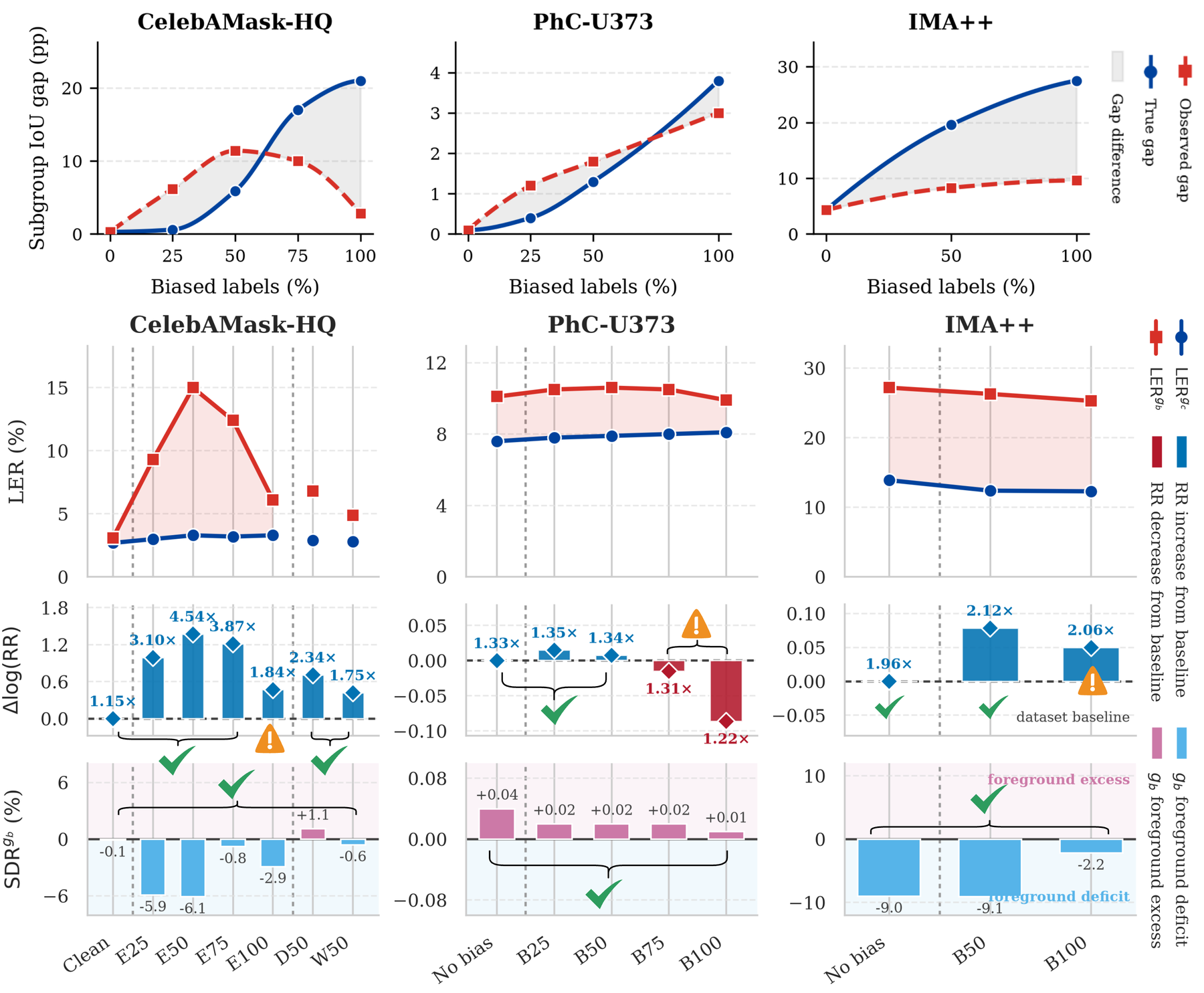
Scores on biased labels do not tell you the real performance

CelebAMask-HQ

PhC-U373

IMA++

true gap (clean labels)observed gap (biased labels)what the biased score misses
Scoring against biased labels hides the bias instead of showing it. We need a way to check the labels that does not need clean labels.
Confident Learning as an audit

Check the training labels using the training set itself

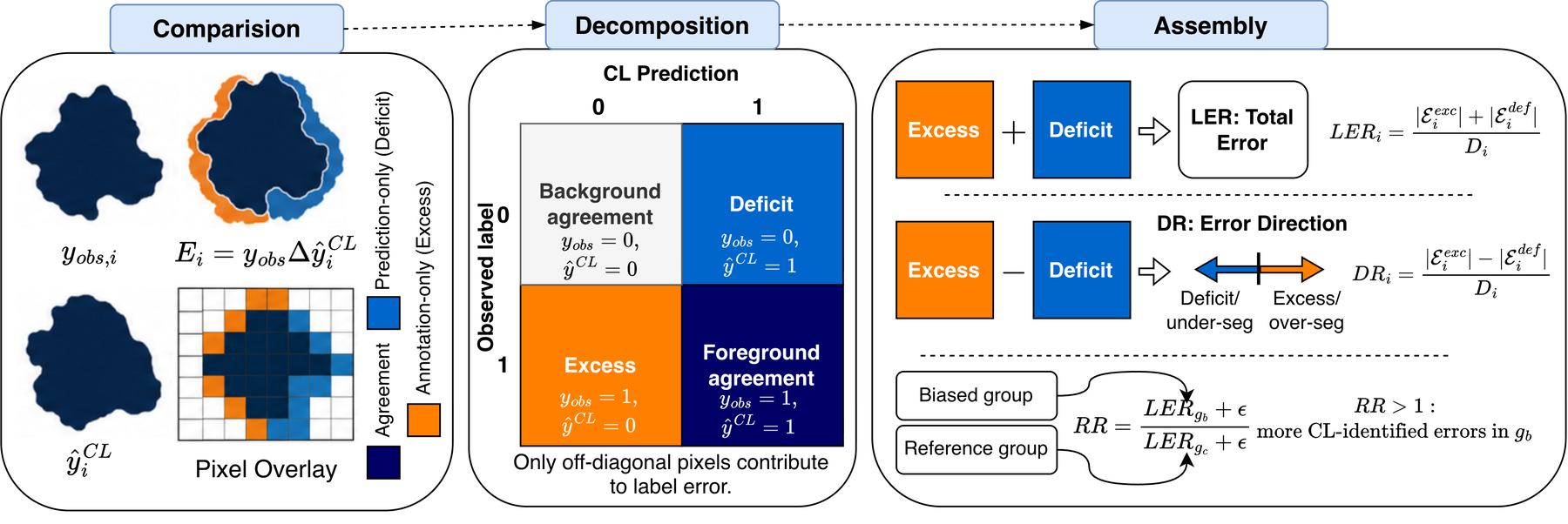
CL decomposition of annotation disagreement
The given mask is compared with the confident prediction, the disagreement is split into excess and deficit, and the three metrics LER, DR and RR are built from them.
Audit results on three datasets
Top: observed versus true performance on all three datasets. Bottom: the audit, computed from the given masks only. LER rises in gb as bias grows, RR moves away from the unbiased baseline, and DR gives the direction: negative for shrunk masks (CelebAMask-HQ), positive for too-big masks (PhC-U373).

What it gives

  • How much error (LER), in which direction (DR), and in which group (RR).
  • The thresholds adapt to the model's calibration, so temperature scaling does not change the result.
  • We checked the audit afterwards against clean masks, and it matches.

Limits

  • It measures disagreement, not truth. When almost all labels are biased (β = 100 %), the model learns the biased style too and the audit reports less than there is.
  • It needs a reasonably good segmentation model.
  • It cannot tell you which style is the correct one. That remains a domain decision.
Subgroup separability

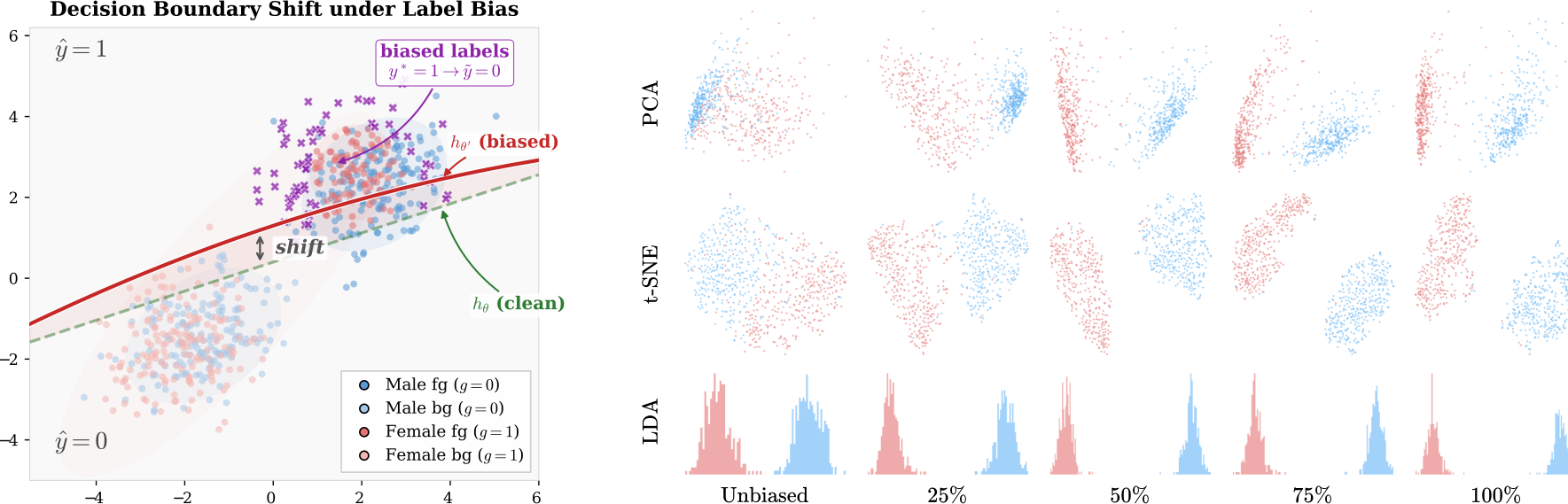
Biased labels teach the network to tell the groups apart

Decision boundary shift and PCA/t-SNE/LDA of encoder features
Left: biased labels move the learned decision boundary. Right: PCA, t-SNE and LDA of CelebAMask-HQ encoder features. Red is gb, blue is gc.
Separability is a symptom, not the problem itself. Removing group information from the features (adversarial training, MMD, CORAL) does not close the real gap, because the labels are still wrong. See our follow-up preprint: Is invariance all you need for algorithmic fairness? Removing demographic information can create new bias. In this paper we use the group signal instead of removing it.
Mitigation

Learn every annotation style, then predict in the clean one

True IoU / true subgroup gap Δ, all compared methods

Mean IoU against clean masks (%) / gap between the groups (percentage points, lower is better). Best per column in bold, our methods shaded. Fairness penalties, feature alignment and noise-robust losses barely move the gap. Subgroup conditioning closes most of it.

Citation

Cite the preprint

Preprint: arXiv:2605.06891. Code, splits, configs and seeds: github.com/ADE-17/label-bias-segmentation.

@misc{parikh2026fairnesslabelbiasimage,
      title={Towards Fairness under Label Bias in Image Segmentation: Impact, Measurement and Mitigation},
      author={Aditya Parikh and Stella Frank and Sneha Das and Aasa Feragen},
      year={2026},
      eprint={2605.06891},
      archivePrefix={arXiv},
      primaryClass={cs.CV},
      url={https://arxiv.org/abs/2605.06891},
}